Fender’s acoustic story is a bit unusual. The company approached flat-top acoustics with an electric-guitar mindset – bolt-on necks, metal neck plates. Those instruments are historically interesting, but they’re also the reason serial numbers often don’t help much for dating Fender acoustics.
Records of Fender acoustic guitars produced from the early 1960s to the 1980s are incomplete, making it difficult to accurately date these instruments. Serial numbers are not helpful for dating these guitars.
So, for Fender acoustics, the most reliable approach is identify the model family + construction features, then date it by known model-year ranges (catalogs/price lists), not only by serial number.
Table of Contents
Fender Acoustic Serial Number Location
The location of serial numbers on Fender acoustic guitars varies by period:
1963 – late-1971 – US-made bolt-on flat-tops.
Models: King/Kingman, Concert, Classic, Malibu, Newporter, Shenandoah, Villager, Wildwood, Palomino, Redondo.
Serial location: Neck Plate (bolt-on neck + metal plate).
Summer 1969-1979 – Japanese F-Series acoustics.
Japanese-made F-Series acoustics were introduced in summer 1969 and were the main Fender acoustics through the 1970s, discontinued in 1979.
Serial location:
- Soundhole Label (sticker) – the serial number is often printed on an internal label. However, this is not always the case; often you can see labels without a serial number (only a model).
Since early 1980s – Modern/Import Fender Acoustics.
Serial numbers for modern acoustics can most often be found inside the sound hole. For example, early 1980s (Gemini II), later imports (DG series) serial shown on an interior round sticker.
If the label is missing/worn, some guitars have the serial marked inside near the neck joint. That “inside near the neck” spot is the neck joint/neck block area you see when you look through the soundhole toward the neck.
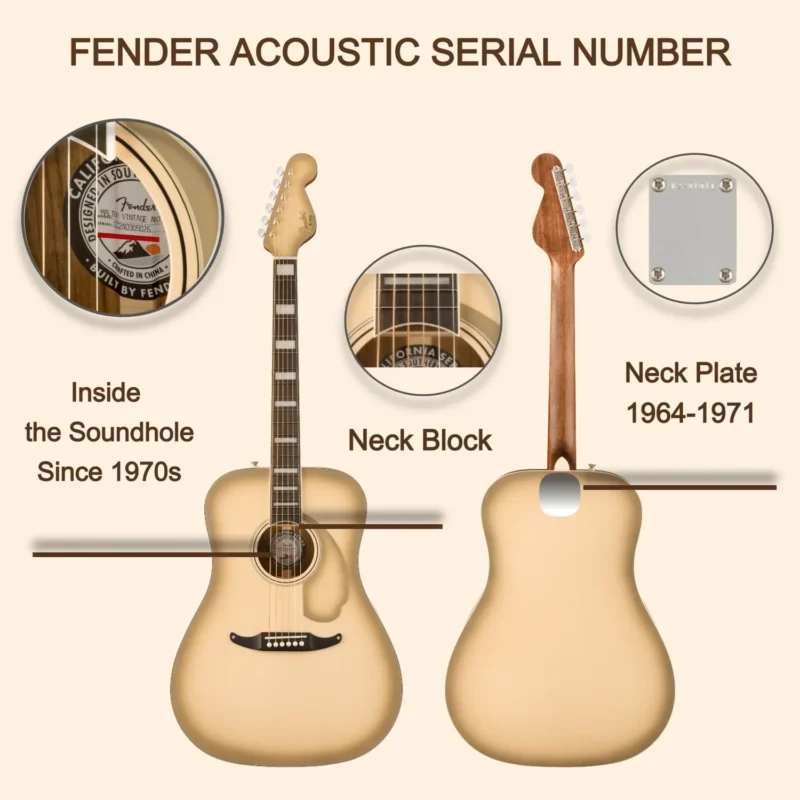
Well, here are the places where you can find the serial number of your Fender acoustic guitar:
- Neck Plate: 1963-1971 US bolt-on acoustics.
- Soundhole Label: 1969-1979 MIJ F-Series (but not always); 1980s-present Fender acoustics.
- Neck Block: a number may be marked inside near the neck joint.
How To Read Fender Acoustic Serial Number?
For early acoustic guitars (1960s-1970s), serial numbers were never archived and are not suitable for precise dating. In most cases, serial numbers correspond to electric guitar models. But this is far from always the case.
To determine the year of production, you first need to look at the model’s production date. Then try checking the serial number in our decoder. But if the decoder indicates a date earlier or later than the model’s production year, it is obvious that the decoder is wrong.
On many modern Fender acoustic guitars, the first digits of the serial number often indicate the year of production (sometimes also the month), but this should be considered approximate.
US-made Fender Acoustic Serial Number (1963 – Late-1971)
The first Fender acoustic guitars appeared in the early 1960s, and in 1964 production was moved to a dedicated acoustic factory in Anaheim.
These early US flat-tops share a few distinctive features that help you identify them quickly:
- Bolt-on neck with a metal neck plate.
- Fender also used an unusual internal stabilizing system on many early instruments (an aluminum rod bracing concept).
- Typical Fender design elements (headstock and hardware).
Models:
- Late 1963: King (later renamed Kingman).
- Dec 1964: Palomino.
- Apr 1965: Malibu and Newporter introduced as budget models.
- July 1965: Shenandoah and Villager (12-strings with Fender’s “hockey stick” headstock design).
- Summer 1966: Wildwood series (dyed-wood finishes).
- Summer 1968: Redondo.
All US flat-top models (Concert, Kingman, Shenandoah, Malibu, Villager, Newporter, Wildwood, Palomino, Redondo) were discontinued by late 1971.
The tables below are the best estimates based on available data from Fender’s price lists and catalogs, starting in 1968. This guide helps determine the approximate age of your guitar and the types of wood used.
Early US-Made Acoustic Guitars
These early U.S.-made acoustic guitars had laminated construction, bolt-on necks, through-body tension rods and Stratocaster-styled headstocks.
| Model | Years | Materials |
|---|---|---|
| Concert | 1963-1970 | Spruce top; mahogany, rosewood, vermilion, or zebrawood back and sides |
| Folk | 1963-1964 | Spruce top, mahogany back and sides |
| Kingman | 1965-1971 | Spruce top, rosewood or vermilion back and sides |
| Malibu | 1965-1971 | Spruce top, mahogany back and sides |
| Newporter | 1965-1971 | Spruce top, mahogany back and sides |
| Palomino | 1968-1971 | Spruce top, mahogany back and sides |
| Redondo | 1969-1971 | Spruce top, mahogany back and sides |
| Shenandoa XII | 1965-1971 | Spruce top, mahogany back and sides |
| Villager XII | 1965-1969 | Spruce top, mahogany back and sides |
| Wildwood | 1966-1971 | Spruce top, dyed figured beechwood back and sides |
Tarrega Acoustic Guitars
Tarrega guitars were made in Sweden and distributed by Fender from the mid- to late 1960s. These guitars had laminated construction.
| Model | Years (T0) | Materials |
|---|---|---|
| FT108 (Flat-top) | 1968 | Spruce top, mahogany back and sides |
| FT110 (Concert) | 1968 | Spruce top, mahogany back and sides |
| FT111 (Concert) | 1968 | Spruce top, maple back and sides |
| FT112 (Grand Concert) | 1968 | Spruce top, mahogany back and sides |
| FT113 (Grand Concert) | 1968 | Spruce top, mahogany back and sides |
| FT114 (Grand Concert) | 1968 | Spruce top, maple back and sides |
| FT115 (Grand Concert) | 1968 | Spruce top, mahogany back and sides |
| FT116 (Grand Concert) | 1968 | Spruce top, rosewood back and sides |
Regal Acoustic Guitars
These early acoustic guitars were distributed by Fender from the mid- to late 1960s. They also had laminate construction.
| Model | Years (To) | Description |
|---|---|---|
| R-200 | 1969 | Student model flat-top Spanish guitar |
| R-205 | 1969 | Student concert grand flat-top |
| R-210 | 1969 | Standard-size flat-top Spanish guitar |
| R-215 | 1969 | Tenor guitar |
| R-218 | 1969 | Folk, concert grand |
| R-220 | 1969 | Regal classic guitar |
| R-230 | 1969 | Auditorium-size flat-top Spanish guitar |
| R-235 | 1969 | Jumbo flat-top Spanish guitar |
| R-240 | 1969 | Student auditorium-size archtop guitar |
| R-250 | 1969 | Auditorium grand archtop guitar |
| R-251 | 1969 | Auditorium grand archtop guitar |
| R-260 | 1969 | Cutaway auditorium grand archtop guitar |
| R-261 | 1969 | Cutaway auditorium grand archtop guitar |
| R-265 (3/4 size) | 1969 | 3/4-size student electric |
| R-270 | 1969 | Electric single-cutaway archtop, thin body |
| R-272 | 1969 | Electric single-cutaway archtop, thin body |
| R-273 | 1969 | Electric double-cutaway archtop, thin body |
| R-275 Baritone Ukulele | 1969 | Baritone ukulele |
Japanese F-Series Serial Number (Summer 1969-1979)
Fender introduced Japanese-made F-Series acoustics in summer 1969. After the flat-top models were discontinued in the US, F-Series became essentially Fender’s main line of acoustic guitars throughout the 1970s.
Here are some signs to help you identify F-series guitars:
- Early guitars: multiple pickguard screws, standard neck heel, and 3-on-a-side tuners with various steel/nylon models.
- By around 1972, notes changes like: no pickguard screws, a more Martin-style teardrop pickguard, a small ‘dip’ at the center top of the headstock, and a Fender script logo.
The Japanese F-Series were eventually discontinued in 1979.
F-Series Chart
Acoustic guitars imported from Asia.
| Model | Years | Materials |
|---|---|---|
| F1000 | 1969-1973 | Laminated hardwoods |
| F1010 | 1969-1973 | Spruce top, mahogany back and sides |
| F1030 | 1969-1973 | Spruce top, mahogany back and sides |
| F1040 (Classical) | 1969-1973 | Spruce top, mahogany back and sides |
| F1050 | 1969-1973 | Spruce top, mahogany back and sides |
| F1060 | 1969-1973 | Spruce top, mahogany back and sides |
| F1070-12 | 1969-1973 | Laminated hardwoods |
| F115 | 1977-1987 | Solid spruce, top jacaranda back and sides |
| F15 (Concert) | 1973-1981 | Spruce top, nato back and sides |
| F25 (Auditorium) | 1972-1981 | Spruce top, nato back and sides |
| F3 | 1981 | Spruce top, mahogany back and sides |
| F35 | 1972-1981 | Spruce top, obankole back and sides |
| F45 | 1972-1974 | Spruce top, mahogany back and sides |
| F5 | 1980-1981 | Spruce top, mahogany back and sides |
| F5-12 | 1980-1981 | Spruce top, mahogany back and sides |
| F50 | 1980 | Solid spruce top, rosewood back and sides |
| F55-12 | 1972-1980 | Spruce top, bubinga back and sides |
| F65 | 1972-1981 | Spruce top, rosewood back and sides |
| F75 | 1974-1980 | Solid spruce top, rosewood back and sides |
| F80-12 | 1977-1981 | Solid spruce top, rosewood back and sides |
| F85 | 1974-1980 | Solid spruce top, rosewood back and sides |
| F95 | 1974-1980 | Solid spruce top, solid rosewood back and sides |
| FC10 (Classical) | 1972-1981 | Spruce top, mahogany or chitora back and sides |
| FC10 ¾ (Classical) | 1972-1981 | Spruce top, nato back and sides |
| FC20 (Classical) | 1972-1981 | Spruce top, rosewood back and sides |
| FC30 (Classical) | 1972-1981 | Cedar top, rosewood back and sides |
| FC40 (Classical) | 1972-1981 | Cedar top, rosewood back and sides |
| FJ70 (Jumbo) | 1980-1981 | Solid spruce top, rosewood back and sides |
Modern Fender Acoustic Serial Number
Fender renewed its focus on acoustic instruments from the late 1980s into the 1990s, and also expanded its product line:
- By 1990, Fender offered a sizable acoustic lineup including California, Gemini, and F-series instruments.
- 1993: SX and Telecoustic series introduced.
- 1995: DG and Spring Hill models.
- 2000s: Grand series, Global Design and more.
1980s – Early 1990s Import Acoustics
- California Series: imported from Japan (1982-1985), then Korea (1985-1992).
- Gemini Series (Korea): 1984-1990.
- Standard Series (Asia): 1982-1990.
Data on the acoustics of models from the 1980s – early 1990s is incomplete, so don’t expect a consistent “serial number = year” explanation for all models. Use the “model name + year” tables first.
Gemini Series
Acoustic guitars imported from Korea, distributed in the U.S. by Midco.
| Model | Years | Materials |
|---|---|---|
| Gemini I (Classical) | 1984-1988 | Spruce top, nato back and sides |
| Gemini II | 1984-1987 | Spruce top, nato back and sides |
| Gemini IIE (Electric) | 1987-1990 | Spruce top, nato back and sides |
| Gemini III (Black) | 1987-1988 | Spruce top, mahogany back and sides |
| Gemini IV (White) | 1987-1990 | Spruce top, mahogany back and sides |
California Series
Acoustic guitars imported from Japan since 1982 to 1985, then imported from Korea since 1985 to 1992.
| Model | Years | Materials |
|---|---|---|
| Avalon (Folk) | 1985-1992 | Spruce top, nato back and sides |
| Balboa | 1983-1987 | Solid spruce top, mahogany back and sides |
| Capistrano | 1983-1987 | Solid spruce top, rosewood back and sides |
| Catalina | 1983-1992 | Spruce top, mahogany back and sides |
| Concord | 1987-1992 | Spruce top, nato back and sides |
| Del Mar | 1983-1989 | Spruce top, rosewood back and sides |
| El Rio | 1983-1987 | Solid spruce top, sycamore back and sides |
| La Brea (Black) | 1987-1992 | Spruce top, mahogany back and sides |
| La Brea (Maple) | 1992-1995 | Spruce top, flame maple back and sides |
| La Brea (Natural) | 1990-1992 | Spruce top, mahogany back and sides |
| La Brea (Sunburst) | 1990-1992 | Spruce top, mahogany back and sides |
| Laguna | 1986-1988 | Spruce top, redwood back and sides |
| Malibu | 1983-1992 | Sycamore top, back and sides |
| Montara (Black) | 1990-1992 | Spruce top, mahogany back and sides |
| Montara (Maple) | 1992-1995 | Spruce top, flame maple back and sides |
| Montara (Natural) | 1990-1992 | Spruce top, mahogany back and sides |
| Montara (Sunburst) | 1990-1992 | Spruce top, mahogany back and sides |
| Montclair | 1987-1988 | Spruce top, mahogany back and sides |
| Newporter | 1983-1992 | Mahogany top, back and sides |
| Redondo | 1983-1990 | Spruce top, mahogany back and sides |
| San Luis Rey | 1990-1995 | Spruce top, rosewood back and sides |
| San Marino | 1990-1992 | Spruce top, mahogany back and sides |
| San Miguel | 1990-1992 | Spruce top, mahogany back and sides |
| Santa Maria XII | 1988-1992 | Spruce top, mahogany back and sides |
| Santa Rosa | 1989-1990 | Basswood, Semi-solid body electric/acoustic |
Standard Series
Acoustic guitars imported from Asia, distributed in the U.S. by Midico.
| Model | Years | Materials |
|---|---|---|
| F200 | 1982-1988 | Spruce top, mahogany back and sides |
| F210 | 1982-1988 | Spruce top, mahogany back and sides |
| F210S | 1988-1990 | Solid spruce top, mahogany back and sides |
| F210LH | 1982-1988 | Spruce top, mahogany back and sides |
| F220SB | 1982-1988 | Spruce top, mahogany back and sides |
| F230 | 1982-1988 | Spruce top, rosewood back and sides |
| F230CE | 1988-1990 | Spruce top, rosewood back and sides |
| F240A | 1982-1988 | Spruce top, mahogany back and sides |
| F250 | 1982-1988 | Spruce top, rosewood back and sides |
| F260S | 1987 | Solid spruce top, rosewood back and sides |
| F265C | 1987 | Spruce top, rosewood back and sides |
| F270SCE | 1987 | Solid spruce top, rosewood back and sides |
| F310-12 | 1985-1988 | Spruce top, mahogany back and sides |
| F330-12 | 1982-1987 | Spruce top, rosewood back and sides |
| F360S-12 | 1987 | Solid spruce top, rosewood back and sides |
| FC100 | 1982-1988 | Spruce top, mahogany back and sides |
| FC110 | 1982-1988 | Spruce top, ovangkol back and sides |
| FC120 | 1982-1988 | Spruce top, rosewood back and sides |
| FC130S | 1987 | Spruce top, rosewood back and sides |
Mid-1990s Import Acoustics
- DG Series (imported from China, Indonesia, and Korea) starting in 1995-1996 depending on model.
- AG Series (Korea) 1994-1995.
- SX/CX Series (Korea) mainly 1992-1995.
Many guitars from these lines show an all-numeric serial on the label. In practice, the first two digits often look like the year (e.g., a DG-21S example with serial 95051737). Still, because Fender did not archive acoustic serials, treat this as a hint, not a “decoder.”
DG Series
Acoustic guitars imported from China, Indonesia, and Korea.
| Model | Years | Materials |
|---|---|---|
| DG3 | 1996 – 1998 | Spruce top, mahogany back and sides |
| DG5 | 1995 – 1998 | Nato top, mahogany back and sides |
| DG10 | 1995 – 1997 | Spruce top, mahogany back and sides |
| DG15-BLK | 1995 – 1996 | Spruce top, mahogany back and sides |
| DG15-NAT | 1997 | Spruce top, mahogany back and sides |
| DG15-SB | 1995 – 1996 | Spruce top, mahogany back and sides |
| DG17-NAT | 1996 – 1998 | Spruce top, nato back and sides |
| DG17E-NAT | 1996 – 1998 | Spruce top, nato back and sides |
| DG18-BLK | 1996 – 1998 | Spruce top, mahogany back and sides |
| DG18-NAT | 1996 – 1998 | Spruce top, mahogany back and sides |
| DG18-SB | 1996 – 1998 | Spruce top, mahogany back and sides |
| DG18 LH | 1996 – 1998 | Spruce top, mahogany back and sides |
| DG18-12-NAT | 1996 – 1998 | Spruce top, mahogany back and sides |
| DG18CE | 1996 – 1998 | Spruce top, mahogany back and sides |
| DG19 | 1996 – 1998 | Solid spruce top, rosewood back and sides |
| DG19CE-NAT | 1996 – 1998 | Solid spruce top, rosewood back and sides |
| DG19CE-SB | 1996 – 1998 | Solid spruce top, rosewood back and sides |
| DG30-12 | 1996 | Solid spruce top, mahogany back and sides |
| DG30S | 1996 | Solid spruce top, mahogany back and sides |
| DG30S LH | 1996 | Solid spruce top, mahogany back and sides |
| DG30SCE-BLK | 1996 | Solid spruce top, mahogany back and sides |
| DG30SCE-NAT | 1996 | Solid spruce top, mahogany back and sides |
| DG30SCE-SB | 1996 | Solid spruce top, mahogany back and sides |
| DG31-12 | 1996 – 1999 | Spruce top, mahogany back and sides |
| DG31S | 1996 – 1999 | Solid spruce top, mahogany back and sides |
| DG31S LH | 1996 – 1999 | Solid spruce top, mahogany back and sides |
| DG31SCE-BLK | 1996 – 1999 | Solid spruce top, mahogany back and sides |
| DG31SCE-CSB | 1996 – 1997 | Solid spruce top, mahogany back and sides |
| DG31SCE-NAT | 1996 – 1999 | Solid spruce top, mahogany back and sides |
| DG40S | 1996 | Solid spruce top, rosewood back and sides |
| DG40S-12 | 1996 | Solid spruce top, rosewood back and sides |
| DG40SCE-NAT | 1996 | Solid spruce top, rosewood back and sides |
| DG95 | 1996 | Spruce top, nato back and sides |
AG Series
Acoustic guitars imported from Korea.
| Model | Years | Materials |
|---|---|---|
| AG10 | 1994-1995 | Spruce top, mahogany back and sides |
| AG15 | 1994-1995 | Spruce top, mahogany back and sides |
| AG20 | 1994-1995 | Spruce top, rosewood back and sides |
| AG21 | 1995 | Spruce top, mahogany back and sides |
| AG22 | 1995 | Spruce top, rosewood back and sides |
| AG23 | 1995 | Solid spruce top, mahogany back and sides |
| AG25 | 1994-1995 | Spruce top, mahogany back and sides |
SX/CX Series
Acoustic guitars imported from Korea.
| Model | Years | Materials |
|---|---|---|
| 200SX | 1995 | Spruce top, mahogany back and sides |
| 600SX | 1994-1995 | Spruce top, nato back and sides |
| 800SX | 1994-1995 | Spruce top, rosewood back and sides |
| 1000SX | 1992-1995 | Solid spruce top, mahogany back and sides |
| 1100SX | 1992-1995 | Solid spruce top, rosewood back and sides |
| 1105SXE | 1992-1994 | Solid spruce top, rosewood back and sides |
| 1200SX | 1992-1994 | Solid spruce top, mahogany back and sides |
| 1300SX | 1992 – 1994 | Solid spruce top, rosewood back and sides |
| 1500SX | 1992-1994 | Solid spruce top, rosewood back and sides |
| 1505SX | 1992-1994 | Solid spruce top, sycamore back and sides |
| 1600SXE | 1993-1994 | Solid spruce top, rosewood back and sides |
| 150CX | 1995 | Spruce top, meranti back and sides |
| 2100CX | 1994-1995 | Solid cedar top, ovangkol back and sides |
Fender Spring Hill Acoustics (1994-1996)
The Spring Hill Series was Fender’s short-lived, high-end acoustic line, handmade in Spring Hill, Tennessee (USA). Fender described these guitars as custom-crafted, using hand-chosen woods and premium components.
Spring Hill models were produced from 1994 to 1996. Fender contracted The Apprentice Shop in Spring Hill to build these acoustic guitars, and production ceased around 1996 following Fender’s acquisition of Guild; production is usually listed as around 440 guitars.
Models:
- LS-Series (Dreadnought)
LS-10, LS-20, LS-20LH, LS-30 (dreadnought)
LS-40C, LS-50C, LS-60C (dreadnought cutaway) - SB-Series (Jumbo)
SB-15, SB-15SB, SB-25, SB-25SB, SB-35 (jumbo)
SB-45C, SB-55C, SB-65C (jumbo cutaway)
All models are listed with solid Sitka spruce tops, paired with solid mahogany / rosewood / maple back & sides depending on the model number.
Spring Hill guitars commonly show plain numeric serials (no prefix). For example 3135069 and 3485079. Because Fender already pins the series to 1994-1996, the model code (LS/SB + number) is the reliable dating anchor.
Spring Hill Series
Acoustic guitars handmade in Spring Hill, Tennessee.
| Model | Years | Materials |
|---|---|---|
| LS-10 | 1994 – 1996 | Solid spruce top, solid mahogany back and sides |
| LS-20 | 1994 – 1996 | Solid spruce top, solid rosewood back and sides |
| LS-20 LH | 1994 – 1996 | Solid spruce top, solid mahogany back and sides |
| LS-30 | 1994 – 1996 | Solid spruce top, solid maple back and sides |
| LS-40C | 1994 – 1996 | Solid spruce top, solid mahogany back and sides |
| LS-50C | 1994 – 1996 | Solid spruce top, solid rosewood back and sides |
| LS-60C | 1994 – 1996 | Solid spruce top, solid maple back and sides |
| SB-15 | 1994 – 1996 | Solid spruce top, solid mahogany back and sides |
| SB-15SB | 1994 – 1996 | Solid spruce top, solid mahogany back and sides |
| SB-25 | 1994 – 1996 | Solid spruce top, solid rosewood back and sides |
| SB-25SB | 1994 – 1996 | Solid spruce top, solid rosewood back and sides |
| SB-35 | 1994 – 1996 | Solid spruce top, solid maple back and sides |
| SB-45C | 1994 – 1996 | Solid spruce top, solid mahogany back and sides |
| SB-55C | 1994 – 1996 | Solid spruce top, solid rosewood back and sides |
| SB-65C | 1994 – 1996 | Solid spruce top, solid maple back and sides |
IPS Serial Number – Indonesia
IPS is a serial-number prefix commonly seen on Fender entry-level acoustic guitars made in Indonesia. For example, a Fender CD-60 can show country of origin Indonesia with a serial like IPS 2412000841. It also appears on other Fender acoustics such as CD-60CE (Made in Indonesia) and CD-100 (example IPS 161000057).
IPS serial numbers often don’t appear in the Fender decoder, even if the guitar is genuine. There’s speculation that IPS may be related to Samick’s Indonesian production, but this isn’t an official statement from Fender.
How to Read IPS?
Many IPS serials appear to follow a YYMM + unit-id pattern (year/month + number). For example: IPS 2412000841 – 2024/12 + unit id.
Important: Fender has not published an official IPS decoder. Use the YYMM reading as a best-effort estimate, and remember that Fender notes year overlaps are normal in Indonesian serial schemes.
Models where IPS is commonly seen:
- CD-60
- CD-60CE
- CD-100
- CC-60S (starter-pack acoustics)
FAQ
Fender decoder gives me no result for my acoustic guitar serial number. Is it fake?
Not necessarily. Fender acoustic serial numbers were never archived, so a serial may be unhelpful or incomplete for dating instruments.
Why does my Fender acoustic guitar have a model name label but no serial number?
This happens quite often, especially with older imported guitars and some 1970s Fender acoustics. Try checking the neck block.
What’s the easiest way to verify the authenticity of a 1960s Fender acoustic guitar?
Most early US-made Fender acoustics (1960s-early ’70s) have bolt-on neck construction with a metal neck plate. If someone claims “1960s Fender acoustic” but it’s a normal dovetail/set-neck instrument with no Fender-style bolt-on hardware, then they’re obviously not being truthful.
What is IPS on a Fender acoustic guitar serial number?
IPS is a prefix on entry-level Fender acoustics (often Indonesia). Many IPS acoustics don’t show up in systems, even when genuine. In most cases, the first digits after IPS indicate the year and month of issue.
How can I spot a fake Fender acoustic when buying a used guitar?
Check the model using the tables of years of production of Fender acoustics. Check the design in the catalogs and model descriptions to see if it matches the stated one. For example, an early American Fender acoustic guitar should have a bolt-on neck, not a standard acoustic guitar design.
Are vintage Fender acoustic guitars valuable?
Unfortunately, Fender acoustic guitars aren’t collectible. Among the most valuable are early American bolt-on acoustics (1960s – early 1970s). They are uncommon, historically important, and produced in smaller quantities than many later imported models. But even these guitars are not worth much.
What if my Fender acoustic has no serial number?
Missing serial numbers can be caused by several common reasons: labels are worn, removed, or the guitar was manufactured without a serial number on the label (this happens). Look through the soundhole and into the neck block area inside the body. On some acoustic guitars, the serial number may be stamped or marked inside near the neck. If you can’t find anything, you can determine the date by characteristics other than the serial number: the exact model name, design features (neck plate, headstock shape, pickguard style, rosette, tuner type).