If you want to buy or sell a Fender Telecaster, the most important thing you need to know is its price. A Telecaster’s value depends on many factors, but one of the most important is the guitar’s age. To determine when your Telecaster was made, you first need to find the serial number.
Where To Find Fender Telecaster Serial Number?
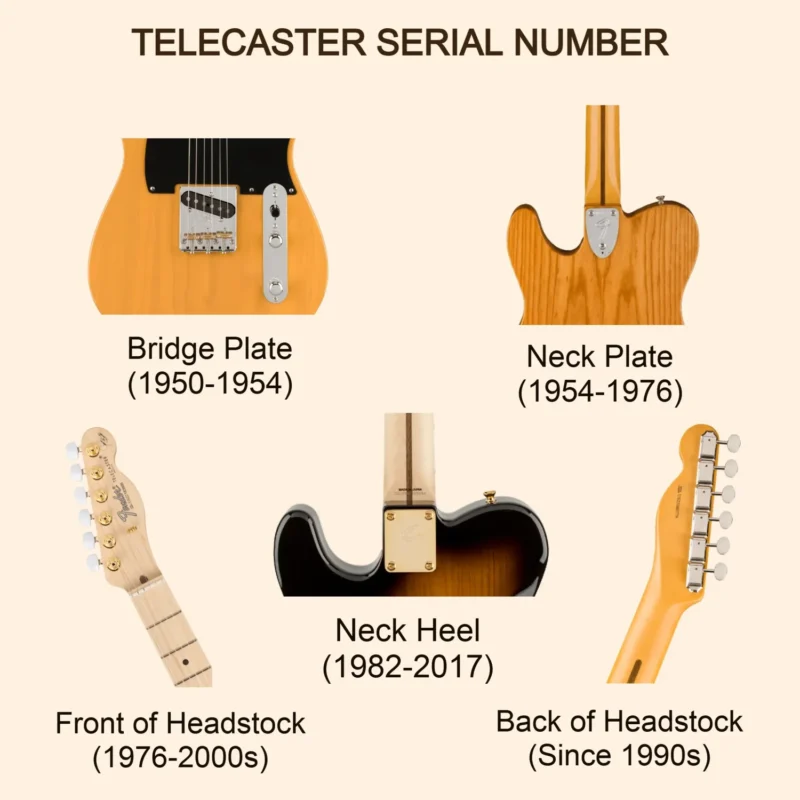
You can find Fender Telecaster serial number in the following locations:
- Bridge Plate, between the pick-up and the saddles (1950-1954, since 1980s for Vintage Reissues).
- Neck Plate (1954-1976).
- Front of Headstock (1976-2000s).
- Neck Heel (1980-2017, Japanese guitars).
- Back of Headstock (Since mid-1990s).
If you can’t find the serial number or it’s illegible, see how to date a Telecaster without a serial number.
If you do manage to find the serial number on your Telecaster, first check it with our Fender Serial Number Decoder. This tool will show you the year and place of manufacture of your guitar.
The database includes all available serial numbers and models, from vintage to modern, including American, Mexican, Japanese, and other. If the serial number is duplicated or can belong to different eras, you will see all possible options.
If the decoder gives NO Result, or you’re unsure, use this Fender Telecaster serial number lookup guide.
As you already know, Fender has placed serial numbers on Telecaster guitars in different parts over the years. This can sometimes be very useful for determining the approximate age of a guitar, especially if the serial number prefix is known.
Select the serial number location and format (number of digits, prefix, etc.) and you will find out detailed information about it:
- Bridge Plate:
- Neck Plate:
- Front of Headstock:
- Neck Heel:
- Back of Headstock:
4-Digit Bridge Plate Serial Number – The First Telecaster Serials (1950-1954)
Most people know the Telecaster as Fender’s first electric guitar. But it all really started with the Esquire.
In March 1950, Fender introduced the Esquire, essentially the first version of a Telecaster-style guitar with a single-coil pickup.
A few months later, in October 1950, Fender released a new version with two pickups called the Broadcaster.
The Esquire was temporarily discontinued. In 1951, Fender reintroduced the Esquire, but it never became as popular as the two-pickup version (and Fender discontinued it in 1969).
In 1951, Fender had a dispute with Gretsch over the Broadcaster (Gretsch had already used the “Broadkaster” name for drums and banjos). Therefore, Fender removed the “Broadcaster” name from the guitar. Due to the lack of a name, they were later nicknamed Nocaster.
Today, the original Nocaster guitars are highly prized by collectors. It’s estimated that around 500 were produced.
Nocaster later became a trademarked Fender name for modern reissues and replicas.
By the fall of 1951, Fender finally settled on the name Telecaster (television was becoming popular), and the new name began appearing on headstock decals.
All early Esquire, Broadcaster, Nocaster, Telecaster models produced from 1950 to 1954 have a serial number stamped on the bridge plate. It consisted of 4 digits. However, determining the exact year of production of these guitars is difficult. The numbers are not always arranged chronologically.
In fact, the only reliable way to find the production date of these guitars is to remove the neck from the body. If the year is unclear, it can also be found on the body under the pickguard or inside the pickup cavity.
But keep in mind that, the first Broadcaster guitars didn’t have a neck date on them.
Esquire, Broadcaster, Nocaster Serial Numbers (1950-1954)
| Serial Numbers | Year | Models |
|---|---|---|
| 0001-1349 | 1950-1952 | Esquire (1950) Broadcaster (1950) Nocaster (1951) Telecaster (1951) |
| 1350-2999 | 1951-1954 | Nocaster Telecaster Esquire |
| 3000-5999 | 1952-1954 | Telecaster Esquire |
Important to note: it wasn’t only the original Telecasters that had four-digit serial numbers on the bridge plate. In the 1980s, Fender released a reissue of the original Telecaster. The serial numbers were also located on the bridge plate and also initially consisted of four digits.
Here are some features of the first reissue that distinguish it from the original:
- Different headstock shape;
- Wider spacing between the dots at the 12th fret;
- Pickups with Alnico 5 magnets;
- Top Hat switch tip.
4-Digit Neck-Plate Serial Number (1954-1956)
Around early summer 1954, Fender switched to a shared serial number system and started putting serials on the neck plate (the metal plate with the 4 screws on the back of the guitar).
Around early summer 1954, Fender switched to a new serial numbering system:
- First, all models were unified into a single numbering system. Previously, each model had its own system.
- Second, serial numbers began to be engraved on the neck plate (the metal plate with four screws on the back of the guitar).
So, Telecasters and Esquires stopped using the old bridge-plate serial system and moved into this new neck-plate pool.
From that point on, serial numbers started again from 0001. And therefore, duplicate serial numbers appeared. So, yes, you can see the same number on two different Telecasters, depending on whether the serial number is stamped on the bridge plate (early system) or on the neck plate (common system).
On top of that, Fender didn’t always use neck plates in perfect order. Plates were stamped in batches and used out of sequence, so the ranges overlap between years. That’s why a 4-digit neck-plate number doesn’t automatically mean one exact year without looking at the rest of the guitar.
If your Tele has a 4-digit serial number use the model and the serial location first, then confirm with the guitar’s features. If you want the most reliable proof, you’ll usually need to check neck/pocket dates and electronics codes as well.
By late 1955, neck-plate serials begin pushing into five digits. However, since the plates were used out of order, some guitars had four-digit numbers in 1956.
Neck-plate Serial Ranges (1954-1956)
| Serial Numbers | Year (approx.) |
|---|---|
| 0001-8000 | 1954 |
| 6000-10000 | 1955 |
| 9000-16000 | 1956 |
5-Digit Neck-Plate Serial Number (1956-1963)
By late 1955, neck-plate serial numbers start showing up as five digits. But Fender still didn’t use plates in a perfectly clean order. So numbers can overlap between nearby years.
In 1959, neck numbers became generally more consistent. However, this isn’t a perfect “date code.” It’s still hard to date a Tele just by the serial number in this period.
Neck-Plate Serial Numbers 1956-1963
| Serial Numbers | Year |
|---|---|
| 9000-16000 | 1956 |
| 16000-25000 | 1957 |
| 25000-30000 | 1958 |
| 30000-40000 | 1959 |
| 40000-58000 | 1960 |
| 55000-72000 | 1961 |
| 72000-93000 | 1962 |
| 93001-99999 | 1963 |
6-Digit Neck-Plate Serial Number (1957-1958)
In 1957-1958, Telecaster serial numbers were sometimes issued with an additional prefix of 0 (zero) or – (dash). For example, instead of 25000, you might see something like ‘025000’ or ‘-25000.’ The reason for this is unclear. But such six-digit neck-plate serial numbers from 1957-1958 are a confirmed fact.
Nobody treats these as a separate “new system.” It’s basically the same neck-plate numbering, just with an extra mark added in front on some plates. Because Fender used plates out of order, these prefixes don’t give you a clean, exact year by themselves. But they do point you to the late-50s.
Neck-Plate Serial Numbers With Prefix
| Prefix | Serial Numbers | Year |
|---|---|---|
| 0 | 16000 – 25000 | 1957 |
| 0 | 25000 – 30000 | 1958 |
| – | 16000 – 25000 | 1957 |
| – | 25000 – 30000 | 1958 |
L-Prefix Neck-Plate Serial Number (1963-1965)
In 1963, Fender introduced a new neck-plate serial style. It starts with the letter L followed by five digits (for example: L25000). These ‘L-series’ plates are most commonly seen on mid-1963 through 1965 instruments.
L-Prefix Serial Numbers 1963-965
| Serial Numbers | Year (approx.) |
|---|---|
| L00001-L20000 | 1963 |
| L20001-L55000 | 1964 |
| L55001-L99999 | 1965 |
6-Digit Serial Number On The F Neck-Plate (1965-1976)
In early 1965, CBS bought Fender. It didn’t change everything overnight. For a while, Fender still used leftover L-series neck plates.
Soon after, Fender introduced a new neck plate with a big ‘F’ logo on it. People usually call it the ‘F plate.’ On these plates, the serial number is typically six digits with no letter prefix.
This style is common through the late 1960s and into the mid-1970s. Just like earlier periods, the numbers aren’t perfectly sequential.
Telecaster F Neck-Plate Serial Numbers 1965-1976
| Serial Numbers | Year (approx.) |
|---|---|
| 100000-110000 | late 1965 |
| 110000-180000 | 1966 |
| 180000-200000 | 1966-1967 |
| 200000-210000 | 1967 |
| 210000-250000 | 1968 |
| 250000-280000 | 1969 |
| 280000-300000 | 1970 |
| 300000-330000 | 1971 |
| 330000-370000 | 1972 |
| 370000-500000 | 1973 |
| 500000-520000 | 1973-1974 |
| 520000-580000 | 1974 |
| 580000-690000 | 1975 |
| 69000-750000 | 1976 |
7-Digit Headstock Serial Number with 76 prefix (mid-1976)
In mid-1976, Fender started moving Telecaster serial numbers from the neck plate to the front of the headstock (right under the Fender logo).
The serial number format has also changed: it now consists of 7 digits, with a bold prefix 76, followed by five other digits 76xxxxx.
This ’76 + five digits’ style was used for a short period, and then Fender quickly moved to the the S6 prefix (meaning 1976) followed by five digits.
S-Prefix Headstock Serial Number (1976-1981)
Starting in 1976, Fender introduced a letter-prefix system to make the decade easier to read. The idea was simple: the letter shows the decade, the first digit hints the year, and then five more digits follow (the production number). So, the format looks like: S6 + 5 digits.
Unfortunately, there’s no consistency here either. At the start of the new year, Fender was still using the old decals with the previous year’s prefix. Thus, S9 decals were still in use in 1980 and even in 1981.
S-Prefix Headstock Serial Number 1975-1981
| Prefix letter | First Digit | Last Digits | Year |
|---|---|---|---|
| S | 6 | 5 digits | 1976 |
| S | 7 | 5 digits | 1977-1978 |
| S | 8 | 5 digits | 1977-1978 |
| S | 9 | 5 digits | 1978-1981 |
E-Prefix Headstock Serial Number (1979-1990)
In 1980, the ‘E‘ prefix was introduced. The ‘E‘ stood for “eighties.” However, decals with the E0 prefix actually began to be used on guitars produced in 1979. Aside from the new prefix, the serial system remained the same.
Once again, old decals were used in the new year. For example, E1 decals can be found on guitars produced in both 1980 and 1983.
Fender company was sold in 1985 to a group led by William Schultz (FMIC). The change of ownership did not affect the format of the serial numbers. Furthermore, most decals with the E4 prefix (1984) were used until 1988, meaning that E5, E6, and E7 decals were never used.
Instead, in 1988 they began to use E8 stickers, and in 1989 – E9. As in the previous decade, E9 decals were still used in 1990.
E-Prefix Headstock Serial Number 1979-1990
| Prefix Letter | First Digit | Last Digits | Year |
| E | 0 | 5 digits | 1979-1981 |
| E | 1 | 5 digits | 1980-1983 |
| E | 2 | 5 digits | 1982-1983 |
| E | 3 | 5 digits | 1982-1985 |
| E | 4 | 5 digits | 1984-1985, 1986-1987 |
| E | 8 | 5 digits | 1988-1989 |
| E | 9 | 5 digits | 1989-1990 |
N-Prefix Headstock Serial Number (1990-1995)
In 1990, Fender introduced a new prefix, N. The letter N stood for the “nineties.” However, instead of N0, stickers with the N9 prefix were mistakenly printed. For a while, these were used on guitars produced in 1990. A few months later, the correct N0 stickers began to be used. So, you can still find guitars produced in 1990 with an N9 sticker on the headstock.
Since 1991, 8-digit numbers have begun to appear: N + 7 digits, the first of which indicates the year.
Front of Headstock Serial Number with N Prefixe 1990-1995
| Prefix Letter | First Digit | Last Digits | Years |
| N | 9 | 5 digits | 1990 |
| N | 0 | 5 digits | 1990-1991 |
| N | 1 | 5-6 digits | 1991-1992 |
| N | 2 | 5-6 digits | 1992-1993 |
| N | 3 | 5-6 digits | 1993-1994 |
| N | 4 | 5-6 digits | 1994-1995 |
| N | 5 | 5-6 digits | 1995-1996 |
Back of Headstock Serial Number with N Prefix (1995-2000)
In mid-1995, Fender began moving serial numbers to the back of the headstock. The format still used the N prefix followed by five or six digits.
Fender also continued to use the remaining stickers from different years, so overlaps are common. For example, N6 can be found on guitars produced in 1996 and 1997, while N9 was used on some guitars produced in 2000.
Back of Headstock Serial Number with N Prefix 1995-2000
| Prefix | First Digit | Last Digits | Years |
|---|---|---|---|
| N | 5 | 5 or 6 digits | 1995-1996 |
| N | 6 | 5 or 6 digits | 1996-1997 |
| N | 7 | 5 or 6 digits | 1997-1998 |
| N | 8 | 5 or 6 digits | 1998-1999 |
| N | 9 | 5 or 6 digits | 1999-2000 |
Z-Prefix Headstock Serial Number (2000-2009)
In 2000, Fender introduced Z-prefix serial numbers for US-made instruments. The system is the same, Z = the 2000s decade. The first digit after Z is the year (Z0 = 2000). The Z prefix is followed by 5 or 6 digits.
The system is more consistent than in earlier periods. But it’s still not perfect. Sometimes old prefixes appear in the new year. For example, Z1 can appear on guitars from 2002, and similar overlaps occur with other Z prefixes. However, this is much less common.
| Prefix | First Digit | Last Digits | Year |
|---|---|---|---|
| Z | 0 | 5 or 6 digits | 2000 |
| Z | 1 | 5 or 6 digits | 2001 |
| Z | 2 | 5 or 6 digits | 2002 |
| Z | 3 | 5 or 6 digits | 2003 |
| Z | 4 | 5 or 6 digits | 2004 |
| Z | 5 | 5 or 6 digits | 2005 |
| Z | 6 | 5 or 6 digits | 2006 |
| Z | 7 | 5 or 6 digits | 2007 |
| Z | 8 | 5 or 6 digits | 2008 |
| Z | 9 | 5 or 6 digits | 2009 |
9-Digit Headstock Serial Number with 10-Prefix (Late 2009-March 2010)
At the end of 2009, Fender introduced a new serial format that started with 10. The ‘10‘ prefix denoted the 2010s. Seven digits followed the prefix (10 + 7 digits).
This format was a transition and was used into early 2010, then it was replaced around March 2010. Fender decided to add country of origin information to the serial numbers.
US-Prefix Headstock Serial Number (Since 2010)
Starting around March 2010, Fender switched to the US prefix format.
US means United States. The next two digits are the year (for example, US10 = 2010, US15 = 2015). The last six digits are the production number.
| Prefix | First Digits | Last Digits | Year |
|---|---|---|---|
| US | 10 | 6 digits | 2010 |
| US | 11 | 6 digits | 2011 |
| US | 12 | 6 digits | 2012 |
| US | 13 | 6 digits | 2013 |
| US | 14 | 6 digits | 2014 |
| US | 15 | 6 digits | 2015 |
| US | 16 | 6 digits | 2016 |
| US | 17 | 6 digits | 2017 |
| US | 18 | 6 digits | 2018 |
| US | 19 | 6 digits | 2019 |
| US | 20 | 6 digits | 2020 |
| US | 21 | 6 digits | 2021 |
| US | 22 | 6 digits | 2022 |
| US | 23 | 6 digits | 2023 |
| US | 24 | 6 digits | 2024 |
| US | 25 | 6 digits | 2025 |
5-Digit Bridge-Plate Serial Number (1988-2012)
In 1982, Fender decided to release a reissue of the ’52 Telecaster, which was called the U.S. Vintage Series ’52 Telecaster. Fender brought back the early-style Tele serial location and started stamping the serial on the bridge plate. Initially, serial numbers were 4-digit, like the original. But by 1988, serial numbers had 5 digits.
In 1998, Fender made some changes to the reissue and gave the series a new name – American Vintage Reissue (AVRI).These guitars also had a 5 digit serial number on the bridge plate. Until mid-2005, the guitars came with a Certificate of Authenticity (COA) indicating the production date.
So, a 5-digit number on the bridge plate means the guitar is a reissue, not an original 1950s Tele.
These bridge-plate reissue numbers are not date-coded. They won’t reliably tell you the exact year by the number alone. For a real date, you have to check neck heel/neck pocket dates (and sometimes pots).
CE-Prefix Headstock Serial Number (1981-1982)
The serial number prefixed with CE was used for the Black & Gold Telecaster model.
In 1981, Fender released a special limited edition Telecaster called the Black & Gold Telecaster, or Collector’s Edition. This Telecaster featured a black finish and gold hardware.
This guitar has a serial number printed on the front of the headstock. The format is CE + 5 digits, with a space (for example: CE 10218). The first digit after CE is used as a quick hint: CE1 = 1981, CE2 = 1982.
V-Prefix Serial Number
The V prefix stands for “Vintage Reissue.” You can find it on the neck plate, on the front of the headstock, and on the bridge plate, depending on the model. These serials can be V + 4, 5, 6 or 7 digits.
In 2012, the American Vintage ’52 Telecaster (AV) series was released, marketed as “pure vintage.” Fender completely redesigned the model to achieve maximum fidelity to the original. The serial numbers of these guitars were located on the bridge plate and consisted of the prefix V + 7 digits.
But, a V number does not equal a specific year. To date the guitar, you still check the neck heel.
Japanese Telecaster Serial Number
In 1982, Fender entered into an agreement with the Japanese company Fuji Gen Gakki to manufacture guitars.
Most Japanese-made Fender Telecasters have the serial number on a decal on the back of the neck, close to the neck joint. It may say “Made in Japan” or “Crafted in Japan”.
Made in Japan Serial Number (MIJ)
From 1982 to 1997, Telecasters used a “Made in Japan” decal. They then replaced it with “Crafted in Japan.” In 2007, Fender returned to using the “Made in Japan” country of origin designation on the serial number decal.
The serial numbers begin with one or two letters. These letters indicate the year of manufacture. But these serial numbers are known for their inaccuracy.
In 2012, Fender changed its numbering scheme, and the new serial number has the prefix JD followed by an eight-digit number. The first two digits of the number indicate the year (For example, JD12001122 = 2012).
In 2017, Fender moved the “Made in Japan” sticker with the serial number on Telecasters to the Back of Headstock. The numbering system remained the same.
MIJ Serial Numbers
| Prefix | Digits | Years |
|---|---|---|
| JV | 5 digits | 1982-1984 |
| SQ | 5 digits | 1983-1984 |
| E | 6 digits | 1984-1987 |
| A | 6 digits | 1985-1986 |
| B | 6 digits | 1985-1986 |
| C | 6 digits | 1985-1986 |
| F | 6 digits | 1986-1987 |
| G | 6 digits | 1987-1988 |
| H | 6 digits | 1988-1989 |
| I | 6 digits | 1989-1990 |
| J | 6 digits | 1989-1990 |
| K | 6 digits | 1990-1991 |
| L | 6 digits | 1991-1992 |
| M | 6 digits | 1992-1993 |
| N | 6 digits | 1993-1994 |
| O | 6 digits | 1993-1994 |
| P | 6 digits | 1993-1994 |
| Q | 6 digits | 1993-1994 |
| S | 6 digits | 1994-1995 |
| T | 6 digits | 1994-1995, 2007-2010 |
| U | 6 digits | 1995-1996, 2010-2011 |
| N | 5 digits | 1995-1996 |
| V | 6 digits | 1996-1997 |
| JD | 8 digits | 2012-2017 (Neck Heel), Since 2017 (Back of Headstock) |
Crafted in Japan Serial Number (CIJ)
The “Crafted in Japan” decal appeared around 1997, connected to the production shift from FujiGen toward Dyna Gakki. Early CIJ production can overlap with MIJ, and for a while both decals were used.
Crafted in Japan is not a “better/worse” mark – it’s mainly a manufacturing-era label, and it does not automatically give you a precise year by itself. CIJ serial prefixes still have overlap because decals were used in batches.
CIJ Serial Numbers
| Prefix | Digits | Years |
|---|---|---|
| A | 6 digits | 1997-1998 |
| O | 6 digits | 1997-2000 |
| P | 6 digits | 1999-2002 |
| Q | 6 digits | 2002-2004 |
| R | 6 digits | 2004-2005 |
| S | 6 digits | 2006-2008 |
| T | 6 digits | 2007-2008 |
A-prefix Bridge-Plate Serial Number
If your Telecaster serial number is stamped on the bridge plate and starts with an A, it usually points to Japanese Telecaster Reissue. These serials are most often seen on 1990s-era and later, but they are not a clean date code.
So, you can’t get an exact year from the A prefix alone. Also, this A-stamp on the bridge plate is NOT the same system as the serial number printed on the neck label.
Don’t try to date it using standard Japanese serial charts.
If you want the real date, use other clues:
- neck heel stamp;
- neck pocket date;
- potentiometer code.
Mexican Telecaster Serial Number
Fender opened the Ensenada, Mexico facility in 1987. The first Fender price list that clearly shows Mexico-made guitars is dated January 1, 1991.
Which Mexico Telecasters were made:
- Standard Telecaster: 1991-2018.
- Deluxe/Nashville-type Teles (extra pickup configs): from late 1990s onward.
- Road Worn Telecasters (relic-style): introduced in 2009.
- Vintera Series: since 2019.
- Player Series Telecaster: launched June 2018, and it replaced the Standard Series.
For MIM Telecaster, the serial number is typically on the headstock. Most of the time you’ll see it on the back of the headstock (especially on newer guitars), often paired with “Made in Mexico” marking.
Mexican serials start with M (Mexico), then a decade marker:
- MN = 1990s
- MZ = 2000s
- MX = 2010s and newer
For the 1990s and 2000s: MN or MZ, then a digit that indicates the year within that decade, then the remaining digits (usually 5 or 6).
For 2010 and later: MX + two-digit that indicates the year + 6 digits (example: MX21xxxxxx).
| Prefix | Digits | Year |
|---|---|---|
| MN0 | + 5 or 6 digits | 1990 |
| MN1 | + 5 or 6 digits | 1991 |
| MN2 | + 5 or 6 digits | 1992 |
| MN3 | + 5 or 6 digits | 1993 |
| MN4 | + 5 or 6 digits | 1994 |
| MN5 | + 5 or 6 digits | 1995 |
| MN6 | + 5 or 6 digits | 1996 |
| MN7 | + 5 or 6 digits | 1997 |
| MN8 | + 5 or 6 digits | 1998 |
| MN9 | + 5 or 6 digits | 1999 |
| MZ0 | + 5 or 6 digits | 2000 |
| MZ1 | + 5 or 6 digits | 2001 |
| MZ2 | + 5 or 6 digits | 2002 |
| MZ3 | + 5 or 6 digits | 2003 |
| MZ4 | + 5 or 6 digits | 2004 |
| MZ5 | + 5 or 6 digits | 2005 |
| MZ6 | + 5 or 6 digits | 2006 |
| MZ7 | + 5 or 6 digits | 2007 |
| MZ8 | + 5 or 6 digits | 2008 |
| MZ9 | + 5 or 6 digits | 2009 |
| MX10 | + 6 digits | 2010 |
| MX11 | + 6 digits | 2011 |
| MX12 | + 6 digits | 2012 |
| MX13 | + 6 digits | 2013 |
| MX14 | + 6 digits | 2014 |
| MX15 | + 6 digits | 2015 |
| MX16 | + 6 digits | 2016 |
| MX17 | + 6 digits | 2017 |
| MX18 | + 6 digits | 2018 |
| MX19 | + 6 digits | 2019 |
| MX20 | + 6 digits | 2020 |
| MX21 | + 6 digits | 2021 |
| MX22 | + 6 digits | 2022 |
| MX23 | + 6 digits | 2023 |
| MX24 | + 6 digits | 2024 |
| MX25 | + 6 digits | 2025 |
How to Date a Fender Telecaster Without a Serial Number?
If your Telecaster has no serial number, or the serial number does not make sense, you can still date the guitar by combining several other clues.
On vintage Telecasters, the best results usually come from checking the:
- Neck Heel Date
- Potentiometer Codes
- Pickup Dates
- Body Date Markings
- Era-correct Features (pickguard, saddles, logo, fingerboard, dots, etc.)
Fender hasn’t always assembled its guitars in perfect order, so the goal isn’t to find one “hidden date,” but to see if all the clues point to the same general period.
It’s completely normal to find small date mismatches. A neck may have been made first and installed later, a pot may have sat in inventory for months, and Fender sometimes used leftover parts from the previous year on newer guitars.
So if one part points to late 1964 and another points to early 1965, that does NOT mean the guitar is fake. What matters is whether the Telecaster is built from period-correct original parts.
See below, what if the dates don’t match.
How Сan you Read the Neck Heel Date on a Telecaster?
On many vintage Telecasters, the most useful factory date is written or stamped on the butt end of the neck – the part hidden inside the neck pocket. To see it, the neck has to be removed carefully. On older guitars, this date is often more useful than the serial number because it usually tells you when the neck itself was made.
Important: The first Fender Broadcaster guitars didn’t have a neck date.
Pencil Dates with Initials (1950-1954)
Early Telecaster necks were usually dated by hand in month-day-year format. You may also see initials written before the date. Those initials are not part of the date – they are worker initials.
A well-known example is TG or TAD, associated with Tadeo Gomez. So a marking like TG 5-18-55 should be read as: worker initials TG, neck dated May 18, 1955.
You can also find the initials XA, which are believed to belong to Xavier Armandez, a Fender employee from 1950 to 1956.
Simpler Pencil Dates (1954 – early 1962)
From the mid-1950s into early 1962, Fender usually shortened the format to month-year. So a mark like 9-57 means the neck was dated September 1957.
One important exception: In early 1959, Fender temporarily stopped listing manufacturing dates until around mid-1959. So, if you don’t find a date on the heel of a Telecaster, it doesn’t mean it’s not genuine; it was probably made in early 1959.
Stamped Codes (March 1962-1969)
Around March 1962, Fender switched to stamping with dark blue and red ink.
This is the period where the model code becomes very important.
The Telecaster stamp looked like this: 3 SEP 63 B. Many people look at the first number and assume it is a day of the month, but on these stamped necks it is actually the neck type code. On Telecasters, the code is 3. Therefore, the code should be read as: 3 = Telecaster, SEP 63 = September 1963, and B = standard-width neck. In this system, A means a narrower neck, B is the normal width, and C is wider.
Green Stamped Codes (1969-1971)
In 1969, Fender began using a new neck marking system, often in green ink. The code now consisted of 6, 7, or 8 digits.
Let’s take an example code: 3145109B. The first digit is the model code. For the Telecaster, Telecaster Thinline, and Esquire, the model code remained the same (3). After that comes the lot number (145), then the month (10), then the year digit (9), and then the neck width letter. So, the code 3145109B can be read as: 3 = Telecaster, 145 = lot, 10 = October, 9 = 1969, B = standard neck width.
Additionally, from 1969 to 1971, another format was found on Telecaster guitars: 3 05 122. In this case, 3 = Telecaster, 05 = probably the batch number, 1 = 1971, 22 = 22nd week.
The new stamps were used in conjunction with the previous format.
8-Digit Stamp Codes (1972-1980)
Beginning in 1972, Fender again changed the neck markings to 8 digits. It was applied in green or red ink. At this time the code numbers for the Telecaster changed. For a standard Telecaster, Telecaster Custom, or Telecaster Thinline, the model code is 13. For a Telecaster Deluxe, the model code is 08.
In the new system, the code is read as: model code/neck code/week/year/day of week. For example, a Telecaster neck stamp 13 03 167 5 can be read like: 13 = Telecaster, 03 = neck code, 16 = 16th week, 7 = 1977, 5 = day of the week (Friday). In this period, neck code 03 is associated with a fretted maple neck or a skunk-stripe neck with rosewood, while 00 or 01 usually indicate rosewood fingerboard.
From 1972 until March 1973, Fender used the old and new neck-stamp systems at the same time. After April 1973, the newer 8-digit style became the standard format.
Dates on the Neck Heel After 1980
Starting in 1976, most Fender guitars, including the Telecaster, began to feature serial numbers on the headstock. Since then, dates on the neck heel have become increasingly rare.
The exception is Reissues, where the dates are placed on the heel of the neck in the same format as for the corresponding period. However, some standard model guitars may feature dates in pencil or stamped on the butt of the neck.
In general, the absence of the classic heel stamp on later Telecasters is completely normal.
How to Determine the Year of a Telecaster by Potentiometer?
The volume and tone pots can tell you when the electronic parts were made. You’ll usually find the codes stamped on the back of the pot casing under the control plate. These codes DO NOT indicate the exact date the guitar left the factory, but they are good for determining the earliest possible build date. The date part comes after the manufacturer code.
Early Telecaster guitars used potentiometers with manufacturer codes 304 and 137.
- 304 stands for Stackpole. Fender used mostly 304 Stackpole pots in the early 1950s.
- 137 stands for CTS (Chicago Telephone Supply). They began to be actively used in early to mid-1963.
On older pots, you may see a 3-digit date, where the first digit is the year within the decade and the next two digits are the week. For example:
304 925 = Stackpole pot, 25th week of 1959.
On later pots, you more often see a 4-digit date, where the first two digits are the year and the last two are the week. For example:
137 7345 = CTS pot, 45th week of 1973.
There are two important warnings here:
- First, pot codes can be hidden under solder or difficult to read, so sometimes you need to check more than one pot.
- Second, Fender sometimes used older pot stock for a long time. A famous example is the large CTS stock bought in 1967, which means guitars made as late as 1973 can still carry 1967-dated CTS pots.
So a pot code should support the dating – not control it by itself.
How Can you Date a Telecaster by the Pickup Dates?
Pickup dates are another useful supporting clue, although they are less consistent than neck dates or pot codes. When present, they are usually found on the back of the pickups.
From 1950 to March 1964, all Telecasters had black-bottom pickups. These pickups DO NOT have a manufacturing date.
From March 1964 until the late 1970s, most Telecasters had gray-bottom pickups. However, black-bottom pickups were also used until 1967.
On early model pickups with a gray bottom, the date may be written in pencil or ink. By the late 1960s, the code became stamped. This code consists of 3-6 digits.
With later pickup codes, the last one or two digits usually indicate the year. For example, a code ending in 69 points you toward 1969, while a code ending in 77 points you toward 1977.
This method can be used for Fender Telecaster pickups produced from the late 1960s to the early 1980s.
It’s worth noting that the pickups were manufactured about half a year before the guitar. Therefore, they cannot indicate the exact date of manufacture of the guitar.
Pickup dates are very useful when they agree with the neck date and pot codes, but if the pickups clearly belong to another era, that can mean they were replaced. That is not rare on old Telecasters.
How to Find Out the Telecaster Body Date?
On the earliest Broadcasters, Nocasters, and Telecasters, the body date was often written in the neck pocket.
By about 1954 or 1955, Fender moved the body date to the area under the bridge pickup, and by 1956 that had become the more typical place to find it. By 1963, body dates were used only rarely.
So if you are checking an early Telecaster and find a body date in the neck pocket, that supports a very early build. If you find it under the bridge pickup, that is more consistent with the mid-1950s into the early 1960s.
But if a Telecaster guitar doesn’t have a body date at all, especially for instruments from the late 1960s, that’s absolutely normal.
How Can You Date a Telecaster by External Features?
If the serial number doesn’t allow you to determine the exact production date, the guitar’s external features can help.
The Telecaster hasn’t undergone any significant changes over the years. But even these small changes make it possible to determine the guitar’s production date with surprising accuracy.
However, it’s important to consider the overall characteristics, not just one detail.
1950 – mid-1954: The Blackguards
Telecasters from this period are usually called Blackguards because they normally have a black phenolic pickguard.
The early 1950s Telecaster had a one-piece maple neck with a strip of walnut along the back where the truss rod was mounted.
Telecasters of this period were caramel butterscotch blond in color.
On original guitars made before 1960, there should be nail holes from the old painting method somewhere under the pickguard or control panel. The body would be supported on nails or pins while the finish dried, and those tiny holes can still be seen today in hidden areas.
From the 1950s to the mid-1960s, Fender headstocks featured the so-called “spaghetti logo.” It looked like thin silver letters with a black outline.
In 1952-1955 Esquires used a gold version of “spaghetti logo” (gold with black trim).
Mid-1954 – 1958: White Pickguard
In 1954, Fender changed the look of the Telecaster.
The black guard was replaced by a single-ply white pickguard.
The original brass saddles gave way to smooth steel saddles.
The finish has changed. Telecasters from this period visually are much brighter and “cleaner” looking than the earlier guitars.
In 1955, the bridge pickup gained staggered pole pieces.
In mid-1956, the old round string tree was replaced by the more familiar butterfly string tree.
In 1958, Fender changed from smooth steel saddles to threaded saddles. Also introduced the short-lived top-loader bridge, where the strings load through the back edge of the bridge plate instead of through the body.
1959 – 1962: Rosewood Fingerboard
In spring 1959, Fender replaced the one-piece maple neck look with a thick solid rosewood fingerboard on many Telecasters.
That same year, Fender also returned from the unpopular top-loader bridge back to the traditional string-through-body.
Also in 1959, Fender introduced the Custom Telecaster. Essentially, it was a more refined standard Telecaster. It featured double body binding (top and back binding), a sunburst finish, and an alder body. For the first time, a rosewood fingerboard appeared on the Custom Telecaster. The headstock bore the inscription “Custom Telecaster.”
In 1960 the position of the nail holes was moved inside the routed cavities.That means when you remove parts and look into the body’s hidden routes, you may spot small nail holes: inside the neck pocket, inside the control cavity route, inside the bridge pickup route.
In the summer of 1962, the thick solid rosewood fingerboard was replaced with a thinner rosewood veneer.
1963 – 1965: Paint Stick
Starting in 1963, another useful sign begins to appear: the paint-stick mark in the neck pocket. Fender used a stick screwed into the neck pocket while painting the body.
By late 1964, the fretboard dots changed from clay to pearloid, and the tuners changed from single-line Klusons to double-line Klusons.
Late 1964 – 1967: Transition Logo
In 1966, the Telecaster adopted a new logo. It featured large gold letters with a thicker black outline.
However, the Custom Telecaster had already begun using the transitional logo around the fall of 1964.
This logo later became known as the transitional logo, as it was associated with a transitional era for the company.
1968 – 1980: Black Logo
Beginning in 1968, Telecaster guitars featured a thicker black logo with a gold border.
The Telecaster Thinline appears in 1968, and the Rosewood Telecaster appears in 1969.
Around 1971 Fender began using two butterfly string trees on Telecaster, Telecaster Deluxe, and Custom Telecaster.
The standard Telecaster kept its traditional 4-bolt neck plate, but Telecaster Thinline and Custom Telecaster moved to a 3-bolt neck plate in early 1971, and the Telecaster Deluxe used a 3-bolt plate from its introduction in 1972.
Important to note: In the 1980s, Fender began using spaghetti-logo and transitional logo again on various models (especially vintage-style ones). Therefore, the style of the logo alone is not enough to prove that a guitar is from the 1950s-60s.
What If The Dates Don’t Match?
Small inconsistencies are normal on vintage Telecasters. The neck can be made weeks or months before the rest of the guitar. Fender also reused leftover parts, and there are documented cases where a guitar from one year carries an earlier neck or earlier pot stock.
There are even known late-1960s neck-stamp oddities where the coding system appears slightly out of step with the rest of the instrument.
A good practical rule is this: if the neck date, pots, pickups, and visible features all fall into the the same period, the guitar is likely original.
If one feature is significantly different, for example, a 1957-style neck date on a body that clearly has late 1960s features, then it’s worth asking. It’s possible that parts were replaced, the guitar was repainted, or the it was assembled from separate parts.
The best dating result is achieved when all characteristics match.